


Tag Archive: machine monitoring software
Is Your Real-Time Shop Floor Data…Real?
Comments Off on Is Your Real-Time Shop Floor Data…Real?Second or third shifts can start like any other: CNCs spin under the watchful glow of monitors, operators move between machines and production looks steady. But in the morning meeting, that’s when staff may start getting curious about dashboard results.
“According to this,” you may say, “half our machines were idle for three hours last night. But they weren’t.”
IT may even have investigated, noting that sensors said they weren’t in cycle. But they were changing tools, running checks and making chips again within two minutes – it just logged all that as downtime.
If you’ve experienced this oddity, despite investing in machine monitoring software, you may find yourself buried in notifications that don’t mean anything and cycle time reports you can’t trust. Your operators will learn (if they haven’t already) quickly to ignore the alerts. The data no longer reflects reality, and worse – now decisions can’t be based on it.
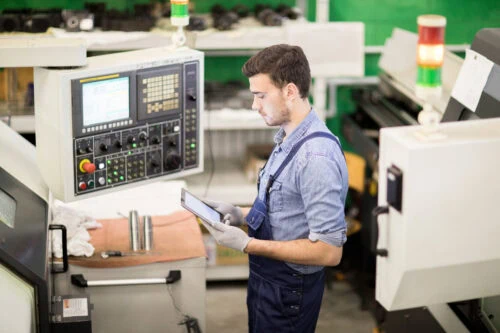
When monitoring alerts don’t match what’s happening on the floor, operators learn to stop responding to them. This is a pattern known as alert fatigue.
Real-time Does Not Automatically = Reliable
Manufacturers have more access to production data than ever. Machine monitoring, MES platforms, OEE dashboards and connected equipment can provide a near-continuous stream of information about machine status, production activity and performance.
But there is an important distinction between data that is collected in real time and data that accurately represents what happened on the shop floor. Having more data does not necessarily mean having better information.
The National Institute of Standards and Technology (NIST) has identified trustworthy data, traceability and effective data governance as important foundations for smart manufacturing. After all, if you can’t trust what the machines are telling you, how do you plan the next job – or even know what’s holding you back?
“If you don’t track the right stats, you don’t know what to practice tomorrow.
You’re counting the wrong swings.”

Manufacturers are collecting more data than ever, yet more dashboards don’t guarantee better decisions.
Three Questions to Vet Your CNC Data Reliability
Before investing in another system, dashboard or AI automation, consider asking:
- Does the data reflect what actually happened?
Compare system-generated machine states with what operators, supervisors and maintenance teams know occurred. - Do you know where the data came from?
You should be able to consistently identify the source of a metric and understand how it was transformed before it reached the dashboard for true CNC data reliability. - Can your team act on it?
A dashboard filled with real-time numbers is not automatically useful. The data should help people identify a loss, understand its cause and decide what to do next.
Turning Machine Data into Meaning
This where an expert manufacturing integrator, like Shop Floor Automations (SFA), serves as a vital partner to your company. With a lengthy background in connecting and modernizing complex machine environments, an experienced integrator will often start CNC data reliability investigations with a blunt question, such as: What does “in cycle” mean to you?
“In cycle,” may not just mean cutting – but tool changes, probing, chip clearance. Your current system, or its configuration, may only recognize power as “on” or “off,” without any shades of gray. A solution such as DataXchange changes that potential. DataXchange, an equipment monitoring and OEE solution from Minitab, provides native flexibility to define exactly what “active” can mean per machine, per process. By collaborating with SFA consulting teams, those definitions can be brought to life to tie real-time machine signals to business context in a single, accurate view.
The results, then, can follow fast: true cycle times, accurate downtime reasons and alerts that actually matter. Maintenance should be able to spot recurring bearing issues before failure. Production should be able to track spindle utilization correctly. And management should sit with confidence, showing data that reflects what is actually happening.
Greg Mercurio, president of SFA, likens the issue to baseball. “If you don’t track the right stats, you don’t know what to practice tomorrow. You’re counting the wrong swings,” says Mercurio. The lesson becomes clear: not all real-time data is real. Trust begins with the right definitions, and with the right partners to turn those definitions into decision-making power.

With accurate data in place, teams tend to gain greater confidence in the decisions they support.
Ready to Get Real Data?
If you’re eager to start answering practical business questions about your true capacity, where downtime is costing you the most or whether to add a machine, another hire or another shift, talk with an SFA expert today about the data you can trust, the processes you need to define and the operational decisions that you need to solve – accurately.