
Skip to Content
Exit

Tag Archive: aging CNCs

CNCs That Are Not Yet Ready to Retire

Comments Off on CNCs That Are Not Yet Ready to Retire

Lengthen Useful Life with CNC USB Upgrades

You have a machine that is 30+ years old. It’s been there since the early days, long before Industry 4.0 was a buzzword and before wireless file transfer was even imaginable. It may be even going by the affectionate nickname of “Trusty.”

Despite its age, the equipment runs like a dream. Its spindles are still tight, axes still accurate within a few microns and its rugged build could chew through titanium like butter. Operators swear by its consistency. “It just knows what to do,” one would say. “Never crashes, never fusses.”

But there’s a catch. And it’s a costly one.

The machine’s control system, still original, can only receive CNC programs via two obsolete methods: a floppy disk drive and a Type I PCMCIA card slot. In an age when everything else on the shop floor has moved to USB, Ethernet or RS232 serial transfer, Trusty’s data interface is like a rotary phone in a world of smartphones.
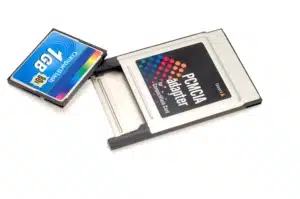
PCMCIA Cards for USB Upgrade

The Bottleneck Begins

Every time a new G-code program needs to be loaded – be it a customer revision, toolpath tweak or entirely new part setup – one of the operators has to break from their routine to hunt down one of the two working 3.5″ floppy disks still in circulation. They probably guard those floppies like gold; one might be labeled “A-Shift Only” in Sharpie.

File sizes have to be trimmed meticulously. Programs have to be split into segments due to the 1.44MB limit. Worse still, perhaps the old laptop that supports the PCMCIA cards only works when plugged into a wall and booted in Safe Mode. You’re constantly worried that it will blue-screen in the middle of a critical job for an already-dissatisfied customer. The resulting delay could push an entire shift back, cause an overnight rush and lead to missed delivery windows. The warnings are clear: the machine isn’t failing mechanically, but it is failing logistically.

Good Machine Health Can Still Be Costly

Even if the machine can still “run well,” the time lost in file prep, operator retraining and manual transfers adds up. Even one mistake in file versioning – say, loading the wrong program because the floppy labels have rubbed off – means scrapping parts, rework or worse, customer complaints or attrition.

Machine Maintenance Work

Then there’s compliance. Traceability and control of removable media may be a major priority, particularly for manufacturers with Federal Contract Information (FCI), yet the tracking of file changes and revisions on a machine that relies on physical media is like trying to manage ERP through Post-it® Notes.

If these challenges sound eerily familiar, you’re among peers. But replacing your aging CNC equipment just to modernize data communication is rarely feasible for most operations. IndustryWeek published this shared opinion from one operations manager at a Midwestern automotive components plant: “We can’t justify scrapping equipment that still produces quality parts just because it lacks connectivity.” Instead, many are choosing to retrofit their legacy equipment – with tangible results.

Retrofitting for Longevity

The process of upgrading floppy drives and PCMCIA cards on older CNC machines can be surprisingly simple, that is, with the right hardware and manufacturing integrator. Shop Floor Automations (SFA), which specializes in delivering machine connectivity through a full suite of hardware and software solutions, refers customers to its USB Connect device to improve obsolete CNC file program transfer processes without retiring the asset. “It’s a ruggedized, plug-and-play unit that lets you load and save programs via USB just like you would on newer machines. You install it on the CNC and connect it to your machine’s RS-232 port, insert a USB flash drive containing your programs and send the file directly into the CNC control. There’s no software setup, no tweaking parameters. It behaves exactly like a serial communication tool, only far faster and easier to use,” explains Greg Mercurio, president of SFA.

These benefits make CNC USB upgrade retrofits increasingly attractive, but Mercurio advises a careful connectivity approach. “Choosing the wrong device or the wrong partner can quickly turn productivity or efficiency issues into unexpected downtime, safety or security issues. Cutting costs and attempting implementations without a well-crafted plan or experienced installer isn’t worth the risk,” says Mercurio.

A New Lease on Machine Life

Programs can now be sent directly from your shop’s programming workstation to Trusty and other older CNC machines, removing the need for floppies, patch cables or ancient laptops. The operator loads programs as if they used a removable USB thumb drive, but without all the marching back and forth between the programming office and CNC.

With this CNC USB upgrade device in place, operators can be empowered to focus on quality parts, not workarounds. Engineering can feel confident in a more streamlined CNC program transfer process. IT can rest easy with full awareness of this process, as well as the roles and responsibilities that result in a compliant and secure course of action. And long-standing equipment, like Trusty, can still run just as well, only now, with the tools to keep pace with the rest of the floor. Learn more about upgrading your existing machinery with expert assistance from SFA technicians by reaching out today.


Tag Archive: aging CNCs

The Extended Lifeline of Windows 10 is a Ticking Clock for Manufacturers

Comments Off on The Extended Lifeline of Windows 10 is a Ticking Clock for Manufacturers

Last month Nucor, North America’s largest steel producer, acknowledged a cybersecurity incident involving unauthorized third-party access to certain IT systems, reported Reuters. As a precaution, Nucor temporarily halted production at multiple facilities while forensic teams and external cybersecurity experts investigated the breach and worked to contain its impact. Nucor’s incident is just one example of how cyber threats exploit aging digital infrastructure – and for many manufacturers, that infrastructure often includes Windows 10. But with Windows 10 reaching end of support on October 14, 2025, there is a deeper risk for shops that continue to rely on aging CNC infrastructure.

Aging CNC infrastructures impact cybersecurity and operational efficiency

This year, manufacturers that don’t upgrade their Windows 10 machines risk missing critical OS-level security updates and losing compatibility with third-party solutions.

The New Reality of Windows 10 End of Life on CNCs

This year Windows 10 will no longer receive critical OS-level security updates. While support for Microsoft 365 apps on Windows 10 has been extended until October 2028, it’s far from a solution for the shop floor. It still means legacy CNC systems and other production technologies running on Windows 10 will become more vulnerable, not less. Compounding the risk, third-party vendors are already phasing out software support, while next-generation manufacturing platforms – from IIoT to real-time analytics – require compatibility with newer operating systems like Windows 11 and Server 2022. The gap between resilient, future-ready IT strategies and older shop floor systems is widening. This blog post explores what manufacturers can, and must, do to close that gap before it spreads into a serious operational liability.

The USB Epidemic: When Compliance and Productivity Collide

For many manufacturers still operating CNC equipment running on Windows 2000, XP or early versions of Windows 10, network segmentation or USB-based file transfers have become the go-to workaround for such outdated systems. However, this tactic is increasingly risky.

CNC program transfers with Windows 10

Running USB-based CNC file transfers have become the go-to workaround using Windows 10 and other outdated systems. However, this tactic is increasingly risky, exposing manufacturers to ransomware events, CMMC noncompliance and operational inefficiencies.

According to Honeywell’s 2022 USB Threat Report, “52% of threats are specifically designed to utilize USB removable devices,” with the vast majority of those threats able to disrupt industrial systems. Pair these threat actors with unsupported software, says Virgina Tech associate professor Lee Vinsel in a recent BBC article, and “there are all kinds of opportunities for failure here, especially when…companies stop supporting old software. Cybersecurity is a huge worry around this issue.” The Department of Defense well understands this concern. Its Cybersecurity Maturity Model Certification (CMMC) 2.0 framework prohibits unmonitored file transfers and insecure endpoints – meaning non-compliance can result in disqualification from federal contracts.

Operational inefficiencies further intensify the risk. Poor CNC program version control and manual CNC program transfers can cost production hours and potentially lower quality output as a result of incorrect or outdated G-code files being loaded at the machine.

Closing the Gap

Rather than investing millions in full machine replacements, many manufacturers are turning to modern Distributed Numerical Control (DNC) systems to serve as their secure industrial network. Solutions like Predator Secure DNC offer targeted upgrades that align with industry compliance frameworks and cyber-hardening strategies. IT and operational leaders can isolate legacy equipment from domain threats, centralize logging across mixed-machine environments, like Fanuc, Okuma, Mazak and others, and meet NIST SP 800-171 encryption standards via FIPS 140-2 validated cryptography.

The Cost of Complacency

Doing nothing may be the most expensive option. The global average cost of a data breach soared to 4.88M, the highest total ever, according to a 2024 IBM report.

For a temporary and limited reprieve, Microsoft offers an Extended Security Updates (ESU) for Windows 10 that starts at $61 per device Year One, with pricing doubling every consecutive year for a maximum of three years after the end of support for Windows 10. Even so, there is no extended Microsoft ESU option after this time period.

Plotting Your Path

To mitigate the risk of your manufacturing operations, IT and operations should take the following steps to prepare for the end of Windows 10 support:

Windows End of Life on CNCs

  1. Conduct a CNC Operating System (OS) and network audit before Q3 2025, identifying all legacy systems still running Windows 10 or earlier.
  2. Prioritize upgrades for machines processing sensitive IP or DoD-controlled projects.
  3. Implement secure DNC options along with Microsoft’s ESU to support phased migrations and DNC retrofits while maintaining compliance and uptime.

Maximizing Grace Periods

Microsoft’s 365 extension for Windows 10 is not a pardon, it’s simply a grace period. Manufacturers who fail to act may find themselves next in line for a costly ransomware event or compliance failure.

Manufacturing integrator Shop Floor Automations (SFA) has worked with hundreds of manufacturers to navigate such transitions securely and efficiently. The path to a resilient, connected shop floor doesn’t begin with rip-and-replace – it starts with informed decisions and trusted partners.

To receive technical guidance for your manufacturing operations, contact the experts at SFA now.